


IO-Link Debugging in Development and Testing
IO-Link Debugging
IO-Link Debugging in Practice: Measure signal waveforms with the IO-Link Signal Exposer and analyze communication with the IO-Link Spy – reproducibly and without improvisation. Anyone who develops or tests IO-Link devices knows two recurring questions:
What does the physical signal really look like?
What happens at the protocol and communication level?
In practice, both levels must be considered. Nevertheless, they are often analyzed with improvised solutions. Cables are cut, adapters are built, or measurements are only performed once. This costs time and is rarely reproducible.
Clean Access to IO-Link Signals
For measurements at the signal level, defined access points are required.
Especially when analyzing:
- Signal quality
- Levels and edges
- Interference
- Timing at the physical level
a direct connection of an oscilloscope or logic analyzer is necessary.
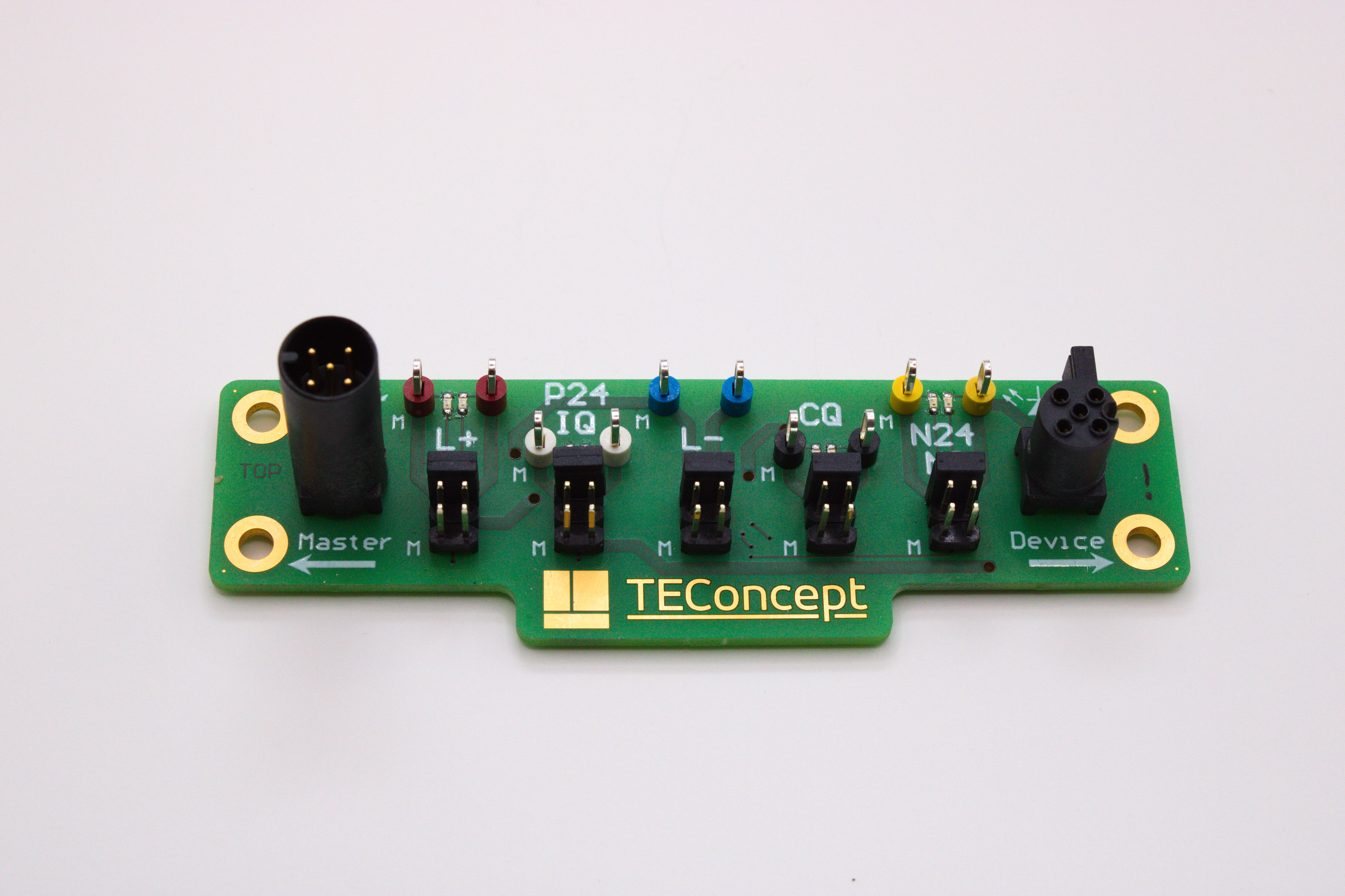
The IO-Link Signal Exposer is a simple helper board for exactly this purpose.
It is plugged between the IO-Link Master and Device and provides all relevant signals via clearly defined measurement points.
Typical Features:
- two M12 connectors (Master / Device)
- dedicated tap points for measuring devices
- LEDs for quick visual signal control
This allows IO-Link signals to be measured without cutting wires or building individual adapters. Measurements remain reproducible and can be repeated at any time under the same conditions.
Analyze IO-Link Communication During Operation
In addition to the signal waveform, the communication itself is often crucial.
Sporadic errors, timing problems, or unexpected states often cannot be reproduced in the lab and only occur during real operation.
The IO-Link Spy enables passive recording of IO-Link communication during operation.
It clips directly onto the IO-Link line and reads the signals contactlessly, without affecting or interrupting communication.
The recorded data is transferred to PC software and can be analyzed there, including:
- at byte and frame level
- at protocol level
- at application level (IODD-based)
- including temporal analysis of requests and responses
Especially for rare errors, this approach is crucial, as the system can continue to run during analysis.
Two Tools, One Debugging Approach
Signal Exposer and IO-Link Spy address different levels but complement each other in daily debugging:
- IO-Link Signal Exposer
Access to the physical signal, measurements with an oscilloscope or logic analyzer, reproducible tests. - IO-Link Spy
Analysis of IO-Link communication during ongoing operation, particularly for sporadic or time-dependent errors.
Together, they enable continuous analysis from the electrical signal to the interpreted IO-Link communication.
Typical Applications
- IO-Link device development
- Application testing and validation
- Troubleshooting sporadic communication problems
- Analysis of signal quality and timing
- Training and demonstration of IO-Link behavior
Efficient IO-Link debugging requires both clean access to the signal and transparency at the communication level. The IO-Link Signal Exposer and the IO-Link Spy provide two practical tools for exactly this, delivering reproducible results without any need for improvisation.
Any Questions?

- +49 761 21443640
- +49 761 21443636
- info@teconcept.de
Would you like to have a look at your existing architecture and check without obligation whether the IO-Link Pathfinder is the right next step for your team?